
The Straight in Poker
What is a straight in poker? It’s a question that plenty of newcomers to the card game ask, whether in competitive poker against others, video poker, or casino poker. The answer is usually quite straightforward and direct. However, there are plenty of intricacies to the straight in poker rules that are worth knowing.
What is a Straight in Poker?
A straight in poker is a winning hand where you align five successive card ranks. For example, you could get a five, six, seven, eight, and nine between your two hand cards and the five community cards of any suit to form a straight.
The Importance of the Ace
Similar to the game of blackjack, the ace has unique rules in poker.
When it comes to the straight in poker rules, the ace can be high or low, but can only bookend a straight.
Here’s what’s meant by the rules of the ace for a poker straight:
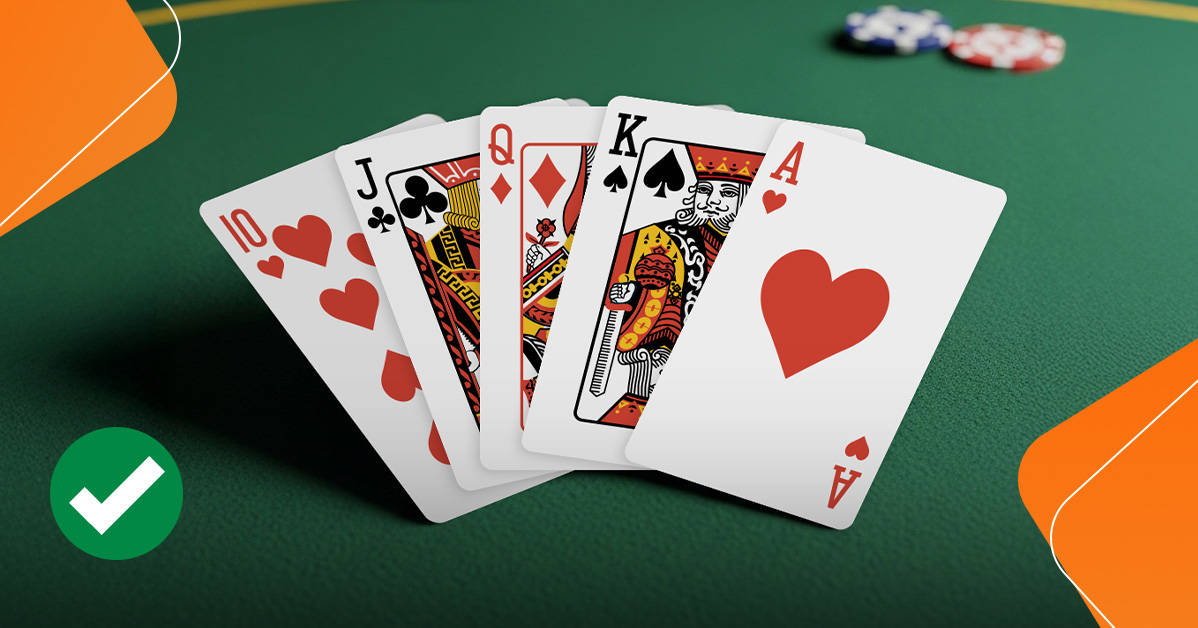
Ace-High Straight (Broadway)
An ace-high straight, otherwise known as the Broadway straight, has an ace at the end of the sequence. So, it would be a ten, jack, queen, king, and ace. Broadway is the highest-value standard straight in poker.
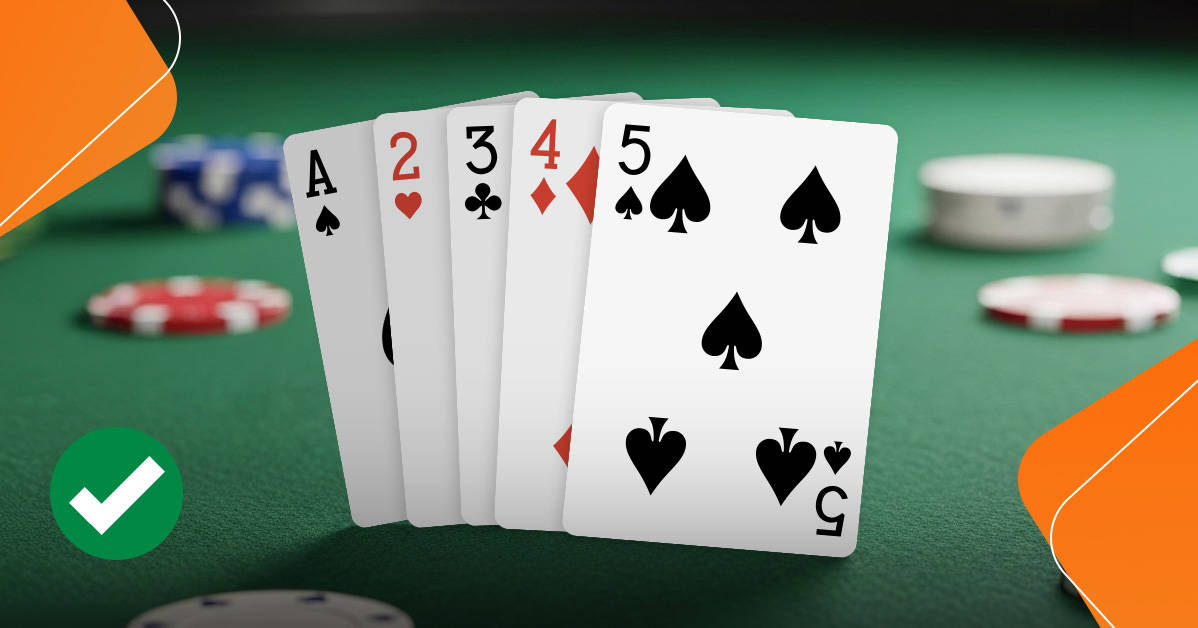
Ace-Low Straight (The Wheel)
The Wheel is an ace-low straight where the ace counts as a one at the beginning of your straight. These hands read as ace, two, three, four, five, and are the lowest-value form of standard straight.
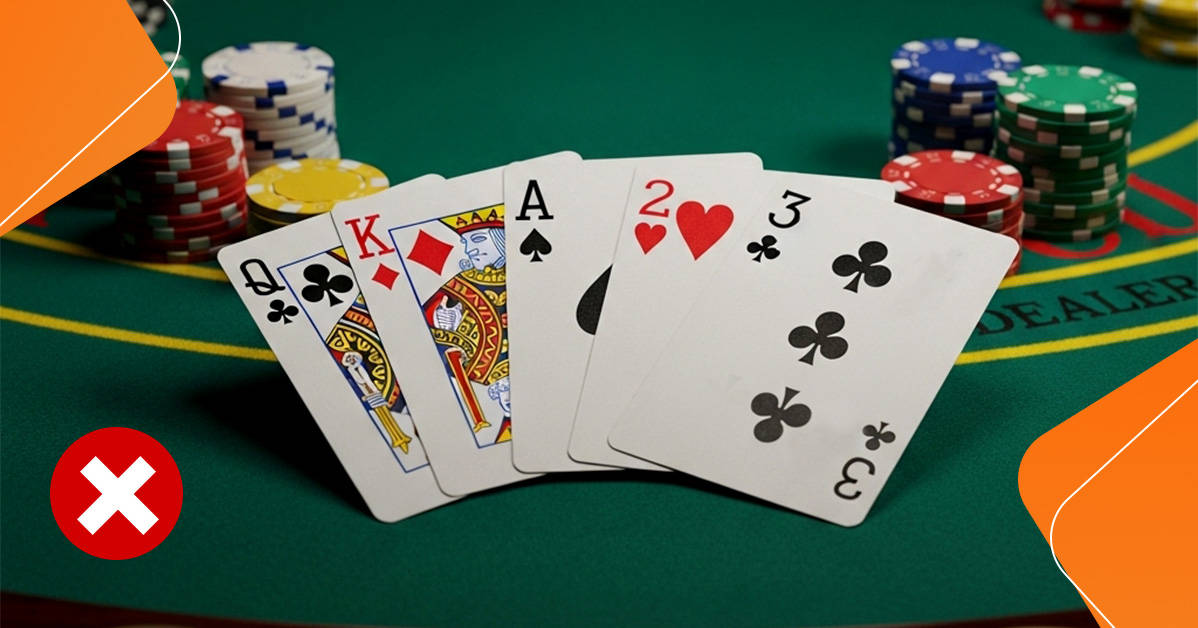
The “No-Wrap-Around” Rule
For the straight in poker rules, an ace can only be high or low. If a sequence of cards would need the ace to be the second, third, or fourth in the sequence, creating a wrap around the ace, it won’t count as a viable straight. This is the “No-Wrap-Around” rule, which keeps ace as either the highest or lowest card in a hand.
How Does a Straight Hold-Up in the Hand Rankings?
Of the ten winning hands of poker, ranging from the low-ranking high card all the way up to a royal flush, the straight ranks as the sixth-best. This is replicated in the probability of a straight being your hand, which in 5-card poker (being dealt 5 cards cold) is at 0.3925 percent or odds of 254:1.
What Hands Rank Higher Than a Straight in Poker?
Above the straight in poker hand rankings, you have:
- The flush
- Full house
- Four of a kind
- Straight flush
- Royal flush
Each of these automatically beats a straight, with the top two being more advanced versions of the straight.
What Hands Rank Lower Than a Straight in Poker?
High card, one pair, two pairs, and three of a kind all rank below a straight in poker.
Regardless of their card values, a straight will always beat any of these four hand types.
The Make-Up of a Straight
Taking the format of Texas Hold’em, a straight will be comprised on one or two of your hand cards and four or five from the community cards. In other formats, you’ll need to get the straight within your hand.
The straight in poker only has to have sequential card ranks. The suits and colours of the cards don’t matter in forming a straight. So, you could have a 7H and 9C in your hand and use the 6D, 8H, and 10S from the community cards to form your straight.
When you think of what a straight is in poker, you can consider the following line as the total sequence that you need to get a bracket of five card ranks within to secure a straight:
- Ace, 2, 3, 4, 5, 6, 7, 8, 9, 10, Jack, Queen, King, Ace
A sequence of any five card ranks within the line above – without wrapping the ace – will count as a straight. That could be [4, 5, 6, 7, 8] or [7, 8, 9, 10, Jack].
How Do Straights Rank Against Each Other?
The problem with straights as a winning hand in poker is that most strong hands will rely on at least three other community cards. This means that there’s a good chance that a close sequence in the middle will be drawn from by other players.
As a result, it’s not uncommon to need to work out the rankings of each straight in poker rules for determining the winner.
The ultimate rule here is that the straight with the highest-ranking top card wins.
If one hand runs a 4, 5, 6, 7, 8, and the other lands a 6, 7, 8, 9, 10, then the latter will win the round. The ten is the highest card in play, so it’s the better straight.
In another example, suppose the table shows A, Q, K, 4, and 2. Your hand has a J and 10, while your opponent has a 3 and 5. You both use the ace to make your straights, but you win because it’s an ace-high rather than a five-high.
Should the rare case occur that a player can actually show a straight of six or even seven successive card values, only the top five will count towards their straight. A six-card or seven-card straight doesn’t mean anything here.
Understanding Draws
Needing five cards to create a viable hand, draws are common for those with an eye on a straight in poker.
Understanding the different types of draws for this hand can help you to see your odds of getting a winning hand and taking the pot.
What is a “Draw”?
In poker, draw doesn’t refer to an instance of two hands being perfectly tied – as in a score draw. Instead, draws are hands that are incomplete and need more cards to improve in value. This could mean needing more exchanges in a variant like Five-Card or more from the community cards in Omaha or Texas Hold’em.
The Open-Ended Straight Draw
The open-ended straight draw is a favourable draw for a straight in poker as it refers to an instance where you have four consecutive cards and just need a high or low card to complete the straight. If you have a 7, 8, 9, and 10, you have an open-ended straight draw looking for a 6 or J.
The Gutshot Straight Draw
As the name implies, you’ve got a hole in the middle of your run with the gutshot straight draw. In this instance, you’d have an 8, 9, J, and Q, needing that one 10 to fill the middle of the succession.
The Double Gutshot Draw
Also known as a double belly buster, the double gutshot draw sees you with two potential inside cards that could make a straight in poker.
For example, if you hold Jack-10 and the board is Ace-Queen-8, a King gives you a high straight, while a 9 gives you a lower straight. This doubles your 'outs' compared to a standard gutshot.
Playing Your Straight (Strategy and Tips)
As the straight is a powerful hand, knowing how to leverage it is key to maximizing your pot.
It’s important to keep in mind that, in games like Texas Hold’em, others will suspect that the straight is on somewhere if three nearby cards are on show.
Playing a ‘Made’ Straight
A ‘made’ straight is the ideal situation to be in with this hand type.
Here, you have all of the cards needed to secure it as your playing hand – in other words, it’s already ‘made’ for you. Be this on the flop, after the turn, or on the river in community games, you’ll want to play fairly cautiously.
While the straight in poker is a fairly high-ranking hand, the three or more community cards needed mean that others at the table may be in with a shot. If the community cards show a 5, 6, 7, for example, you can be a bit more aggressive if you have the 8 and 9, but be more reserved if you’re tailing it with a 3 and 4.
Playing a Straight Draw
Between your hand and the community cards, let’s say that you need one or two more of the right cards to complete your hand. Here, you’re playing a straight draw.
Ideally, you’d have other hands in play or at least a pair to fall back on. This is because, in a round of poker with a fresh deck, you have odds of 254:1 of getting a straight.
Straight draws based on three cards are tough to trust. Those that feature four cards with two coming from the flop are much more favourable and reduce the chances of others at the table matching you. Even so, getting that fifth card, especially with a gutshot straight draw, is still fairly unlikely. The best straight draw is open-ended.
Common Mistakes to Avoid with Straights in Poker
Straights in poker have an uncanny ability to lull players into a false sense of security.
Spurred on by the excitement of landing a hand of five cards, especially when much of the action has been decided by pairs, two-pair, and threes, players often overvalue their hand if it’s made or continue to chase the straight.
While a straight can be a strong winning hand, and the hint of a straight on the table can scare off those without a shot, there are a few common mistakes to keep in mind when playing the hand. To avoid common mistakes made by those who hold a straight, keep these poker errors in mind:
Chasing a Gutshot
Of the kinds of straight draws you can get, the gutshot straight draw is the least likely to pay off. Needing just one number, even if there are four left in the deck, is the worst situation to be in when you think the straight is on.
Most likely, you’ll see this opportunity after the flop, only giving you two shots at one of up to four cards that you need. The double gutshot and open-ended draws are far more likely to pay off because both have two outs (cards that are unseen and can be drawn to complete a hand).
In terms of the absolute best probabilities for a gutshot straight draw to come through, let’s say you have a 7 and 8 in hand and the 10 and J on the flop. From a 52-card deck without anyone else at the table, leaving 47 cards, you have an 8.5 percent shot of getting the 9. On the river, that bumps to 16.5 percent.
Ignoring Board Texture
Particularly when it comes to bringing together a straight in poker, board texture offers a lot of context as to how you should bet. Board texture is defined as being either dry or wet. A dry board on the flop will show three very detached values without helping a flush or straight. Wet boards have cards that help more valuable hands.
Every would-be straight requires a wet board, be it a puddle of two successive card values or a veritable ocean with three successive cards of the same suit. On the latter, two cards that make a straight would be encouraging, but two cards of the same suit would end up with a flush to beat the straight.
As the straight is so heavily reliant on the community cards, you’ve always got to keep in mind that others at the table may have better combinations than you. Further, they’ll suspect that you’re in on the straight or better, which you can also use to your advantage.
Overvaluing the “Sucker End”
The “sucker end” of the straight is when you have what could be the lowest straight available.
Seeing your open-ended draw complete with the low card or kicking off a straight with the first two cards can limit the value of your straight.
After all, with the community cards offering the bulk of any straight, other players could be just as likely to have the other end of the straight. After the flop, if the potential height of the straight increases, the sucker end of the straight in poker only becomes less valuable.